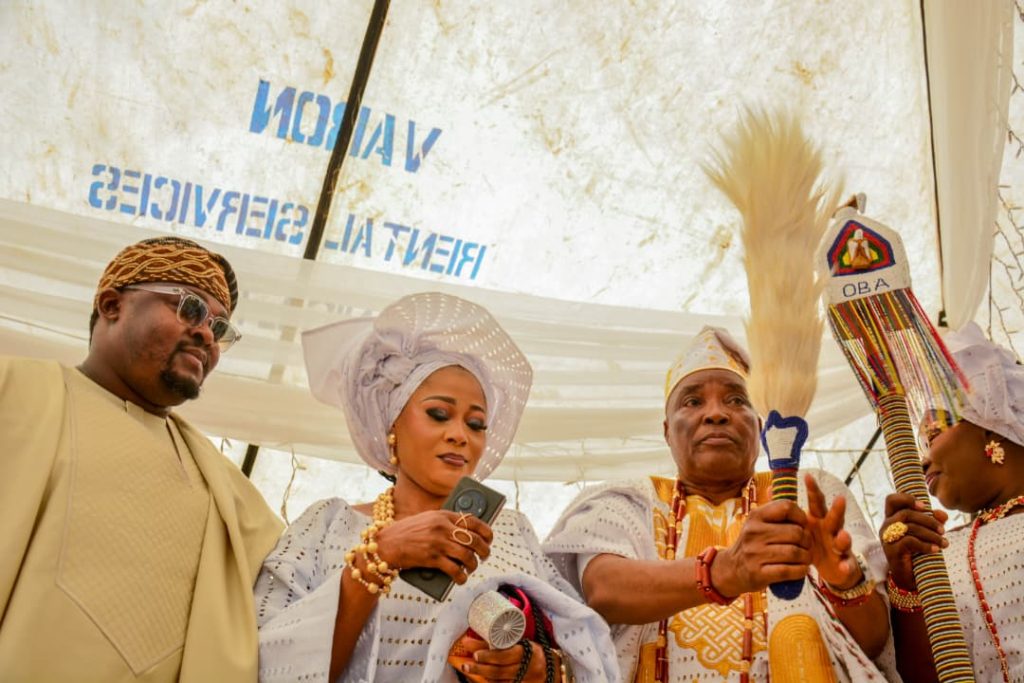
The Executive Chairman of Odogbolu Local Government, Hon. Dr. Babatunde Oyetola Diya, has congratulated His Royal Majesty, HRH Oba Kolawole Abdus-Salam Adekogbe, Gbadewolu I, Koseleri, on his presentation with the Staff of Office as the Onigbile of Igbile-Ijebu Kingdom.
In a congratulatory message issued following the historic ceremony held on Tuesday, August 4, 2026, Hon. Diya described the monarch’s installation as a well-deserved recognition of his exemplary character, integrity, and unwavering commitment to the peace, unity, and development of Igbile-Ijebu Kingdom.
The Council Chairman noted that the ascension of Oba Adekogbe to the revered throne marks the beginning of a new chapter for the kingdom, expressing confidence that the monarch’s reign would be defined by wisdom, justice, peace, and sustainable development while preserving the rich cultural heritage and traditional values of the Ijebu people.
Speaking on behalf of the government and people of Odogbolu Local Government, Hon. Diya extended his warm congratulations to the new traditional ruler, describing the occasion as a significant milestone not only for Igbile-Ijebu Kingdom but also for the entire local government area.
He further reaffirmed the local government’s commitment to maintaining a cordial and productive relationship with the traditional institution, emphasizing the vital role of traditional rulers in promoting peaceful coexistence, community development, and grassroots governance.
Hon. Diya prayed for Almighty God to grant the monarch good health, divine wisdom, strength, long life, and a peaceful reign filled with remarkable accomplishments that would bring lasting progress and prosperity to Igbile-Ijebu Kingdom.
The Executive Chairman concluded by wishing His Royal Majesty, Oba Kolawole Abdus-Salam Adekogbe, Gbadewolu I, Koseleri, a glorious, peaceful, and prosperous reign on the throne of his forefathers.
Health Experts have told women to desist from denying their babies regular breast milk, while having the misconception that breastfeeding causes breasts to sag, adding that sagging occurs as a result of ageing.
This warning was issued on Monday during the flag-off of the 2026 World Breastfeeding Week in Bauchi.
Speaking at a press briefing, the Executive Chairman of the Bauchi State Primary Health Care Development Board, Dr Rilwanu Mohammed, expressed concern that some mothers deliberately deny their children breast milk because they believe breastfeeding makes them look older by causing their breasts to sag.
He warned that denying children breast milk, particularly exclusive breastfeeding, exposes them to malnutrition and other childhood illnesses.
Breastfeeding is not what makes your breasts fall. Your breasts naturally fall with age whether you give it to your children or not,” Mohammed said.
He noted that exclusive breastfeeding remains one of the most effective ways of protecting children from malnutrition and preventable diseases.
Also speaking, the Chief of the UNICEF Bauchi Field Office, Dr Nuzhat Rafique, described breastfeeding as a proven, life-saving practice and urged mothers to adopt optimal breastfeeding practices for the healthy growth and survival of their children.
She said this year’s World Breastfeeding Week theme, ”Breastfeeding for a Sustainable Start in Life: Strengthen What Works,” emphasises the need to build on proven interventions that improve child nutrition.
Rafique commended the Bauchi State Government for approving six months of paid maternity leave, describing it as a major milestone that would enable mothers to exclusively breastfeed their babies.
She also praised the state government for allocating N500m as counterpart funding for the Child Nutrition Fund, expressing optimism that the funds would be released promptly to procure nutrition supplies.
According to her, although more than nine in every 10 mothers in Bauchi breastfeed their children, optimal breastfeeding practices remain low.“As I said, breastfeeding remains a valued practice with more than nine in 10 mothers breastfeeding their children, but unfortunately the optimal practices are not there,” she said.
Rafique disclosed that only 12 per cent of newborns in Bauchi are breastfed within the first hour of birth, while only 26 per cent of infants are exclusively breastfed for the first six months of life.
She explained that babies should be breastfed within the first hour after birth and given colostrum, the first breast milk, which she described as the child’s first vaccination because of the immunity it provides.
“The child should have breast milk immediately after birth without being given water, honey or any local drinks. Those practices introduce germs and expose children to diarrhoea and other infections,” she said.
The UNICEF official noted that poor breastfeeding practices contribute significantly to diarrhoea, respiratory infections and malnutrition, creating a vicious cycle that weakens children and increases the risk of death.
She urged mothers to exclusively breastfeed their babies for the first six months, continue breastfeeding alongside complementary feeding for two years, and maintain adequate birth spacing.
According to her, breastfeeding should not be left to mothers alone, stressing that fathers, families, employers and government institutions all have roles to play in supporting nursing mothers.
She added that family-friendly workplace policies, including the implementation of the state’s six-month paid maternity leave and the establishment of crèches in workplaces, would improve breastfeeding practices and child survival.
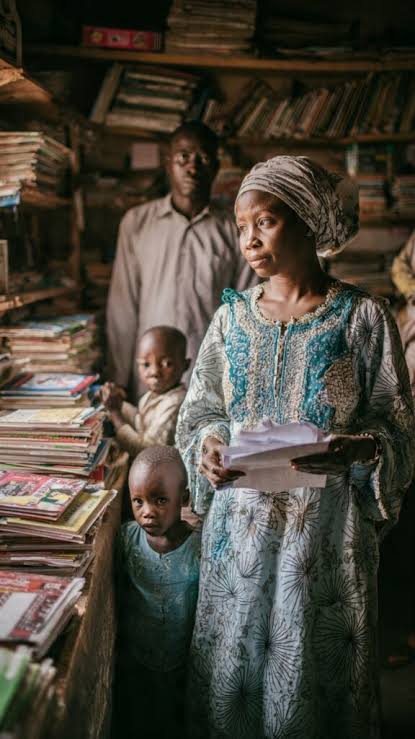
Every September in Nigeria, the same ritual plays out in homes across the country. Parents line up in markets and bookshops with a list in one hand and dwindling cash in the other. The list is from the school. The cash never stretches far enough.
So when the Federal Government says it wants to improve what’s on that list — better textbooks, fewer errors, tighter alignment with the curriculum — most Nigerians nod. Who would argue against better books?
The problem is not the ambition. It is the mechanism now being used to achieve it.
A new policy has quietly entered the education space. Under it, the government will not only vet textbooks, it will grade them. It will rank publishers. And it will narrow the pool of books officially recommended for classrooms across the country to a select few.
On paper, this looks like quality control. In practice, it looks like gatekeeping. And in a country with 60 million children in basic and secondary school, gatekeeping has consequences.
1. A Solution in Search of a ProblemFor years, textbook approval in Nigeria has run through the National Educational Research and Development Council, NERDC. The mandate was straightforward: check the book against the curriculum. If it matches, it gets listed. No trophies, no league tables.It was not a perfect system. Teachers still complained about errors. Distribution was uneven. But it was open. Dozens of publishers, including small indigenous presses in Ibadan, Enugu and Kano, could compete as long as their books met the standard.Now the government wants to go further. Instead of pass/fail, we get scores. Instead of a directory, we get a podium. First place, second place, third.What prompted the change? That is the first question no one has answered with data. If the old system was letting bad books into classrooms, show us the evidence. Which titles? Which subjects? Which years?Policy without evidence is preference dressed as reform. Nigerians deserve the receipts before we upend an entire industry.
2. The Math Doesn’t Add Up
Consider scale. Sixty million learners. Hundreds of thousands of schools. Multiple subjects per class, updated every few years.
Now imagine telling that market that only a handful of publishers will carry the government’s seal of approval. Even the most efficient presses cannot print, warehouse and truck that volume to every LGA without delay.
What happens in the meantime? Scarcity. When supply tightens, price rises. And price is already the single biggest barrier between a Nigerian child and a textbook.
Publishers are also warning about cost. According to industry sources, assessment fees have jumped sharply under the new framework — from roughly N300 to N2,000 per page, plus large subject fees. For a house trying to get a full basic education catalog approved, estimates run into the hundreds of millions of naira.
That money does not vanish. It shows up later, on the price tag parents pay. Or it shows up as closed businesses.
Nigeria’s publishing ecosystem is not just a few big names. It is editors working from spare rooms. Illustrators in Yaba. Printers in Aba. Distributors who know which road to take when the rains come. A ranking system that crowns winners and erases the rest will hollow that ecosystem out at the moment we need more capacity, not less.
3. The Incentive Problem
There is another risk, and it is not theoretical.
Anytime government decides which private companies get to dominate a market worth billions, you create a magnet for influence. Even if no one pays a bribe, the mere possibility that a ranking can be lobbied for or against corrodes trust.
Parents will ask: was this book approved because it is good, or because its publisher is connected? Teachers will ask the same. Students will pay the price either way.
Other countries have faced this and chosen a different path. In many education systems, the state sets a clear floor: curriculum alignment, accuracy, production quality, price. Meet the floor, you’re in. No ranking, no public shaming, no artificial scarcity. The goal is not to pick champions. The goal is to keep bad books out.
Nigeria could learn from that.
4. What Was Missing From The Room
Major policy rarely survives contact with the people it affects unless those people were in the room when it was written.
Publishers were not meaningfully consulted. Neither were teachers who actually use the books, nor school owners managing tight budgets, nor parents already stretched by inflation.
When stakeholders raise red flags early, it is not obstruction. It is early warning. The government should treat it as such and go back to the table.
At LightRay! Media, we believe in two things at once: that Nigerian children deserve textbooks free of errors and politics, and that they deserve textbooks they can actually afford and find.
You cannot have the first without the second.
The Way Forward:
Suspend the ranking.
Keep rigorous assessment. Keep curriculum checks. Keep periodic reviews. But replace the podium with a doorway. Set transparent, measurable minimum standards. Any publisher whose book meets them gets approved. No hierarchy. No artificial winners.
That preserves competition. It protects jobs. It keeps more books in more places at prices more families can manage.
Education reform is not supposed to make the market smaller. It is supposed to make learning bigger.
Nigerian children do not need a ranking of publishers. They need a shelf full of good books, in every classroom, in every state, at a price their parents can pay.
The First Lady, Senator Oluremi Tinubu, on Thursday called for increased vigilance to identify and report online scams targeting young Nigerians.
She described human trafficking as a form of modern-day slavery that had evolved beyond its traditional forms to exploit victims through online scams, forced criminality and transnational organised crime.
In a message to mark the World Day Against Trafficking in Persons, which falls on July 30, the First Lady said the year’s global theme, ‘Trapped Behind the Scam,’ drew urgent attention to a fast-growing dimension of human trafficking that was ensnaring increasing numbers of young Nigerians, including educated graduates, through fraudulent overseas employment and investment offers that led them into exploitation and forced criminality.
She called on individuals, communities and institutions to remain vigilant against the evolving tactics of traffickers.
She said, “Let us remain vigilant, protect the vulnerable, and ensure that no one falls victim of exploitation.
“Through collective action, we can build a safer society where every person can live in freedom, dignity, and hope. We say ‘no’ to human trafficking today.”
The World Day Against Trafficking in Persons, observed annually on July 30 since it was established by the United Nations General Assembly in 2013, is designed to raise awareness of the plight of trafficking victims and promote and protect their rights.
Nigeria remains one of the highest-burden countries for human trafficking in the world, serving simultaneously as a country of origin, transit and destination.
According to the National Agency for the Prohibition of Trafficking in Persons, approximately 156 victims had been rescued since January 2026 alone, with over 300 others repatriated from Ghana and Côte d’Ivoire in 2025.
The agency’s Director-General, Binta Adamu Bello, disclosed last week that over 300,000 people were being trafficked annually into scam compounds across Southeast Asia, with victims forced under threat of violence to run romance scams, crypto fraud and investment schemes targeting victims in the United States, United Kingdom and Canada.
The scam compound model, in which traffickers lure educated young Nigerians with promises of jobs in information technology, digital marketing and cryptocurrency trading before confiscating their passports on arrival and forcing them to commit online fraud, has emerged as one of the most rapidly growing trafficking trends in recent years.
The Youth and Students Wings of the Yayi Progressives Movement (YPM) on Wednesday staged a solidarity trek across major parts of Abeokuta, the Ogun State capital, to reaffirm their support for President Bola Ahmed Tinubu, Governor Dapo Abiodun, and Senator Solomon Olamilekan Adeola (Yayi) ahead of the 2027 general elections.
The participants also declared their backing for Governor Abiodun’s senatorial ambition and Senator Adeola, the All Progressives Congress (APC) governorship candidate in Ogun State.
The solidarity walk, which attracted scores of youth and student supporters, was aimed at demonstrating the group’s commitment to the APC and its key political figures as preparations gradually gathered momentum for the 2027 polls.
The exercise attracted scores of youths, students, party supporters and APC leaders, who converged at the MKO Abiola International Stadium, Kuto, before embarking on a peaceful walk through major streets. Participants carried banners and placards while chanting slogans expressing confidence in the leadership of President Tinubu and commending Senator Adeola for his contributions to grassroots development.
Speaking during the event, the Convener of the Movement, Armstrong ‘Tope Akintunde, said the solidarity trek was aimed at mobilising young people to remain actively involved in the democratic process while reaffirming their commitment to the ideals of the APC.
According to him, “This solidarity trek is for our three leaders President Bola Ahmed Tinubu, Governor Dapo Abiodun and Senator Solomon Olamilekan Adeola (Yayi). He said Senator Adeola has made remarkable impacts in the lives of young people across Ogun State through empowerment programmes and developmental initiatives.
“We have every reason to support him because we are confident that, come 2027, he will record a landslide victory. Over the past three years, President Tinubu’s reforms and Senator Yayi’s track record in empowerment, infrastructure development and constituency projects have continued to inspire many young people to support their leadership.”
Also speaking, the Co-Convener of YPM, Hon. Kehinde Odeneye, said the movement was committed to promoting the ideals of the APC, describing Senator Olamilekan Adeola as the group’s leader and governorship candidate.
He urged residents of Ogun State to continue supporting policies and programmes aimed at promoting economic growth, creating jobs and improving the standard of living across the state.
The Youths and Students Wing described the solidarity trek as peaceful and orderly, noting that it was organised to promote unity, encourage political participation and sustain youth engagement in preparation for the 2027 general elections.